

By Peter Duthie
Is your vision as good as it used to be?
Introduction
The human eye is believed to have evolved out on the plains of Africa, with distant horizons, bright natural light giving a small pupil size (and without paperwork), it could keep itself perfectly adapted to its environment. Today we spend our time indoors with relatively poor light giving a larger pupil: a major part of our day is spent focusing closely at paperwork or a computer screen and any focusing difficulty is immediately ‘corrected’ with prescription lenses. These factors conspire together to deny our eyes the opportunity to recover on their own. A little understanding of the processes involved can help us to guide our eyes back towards normal unaided vision
The Anatomy of Focusing
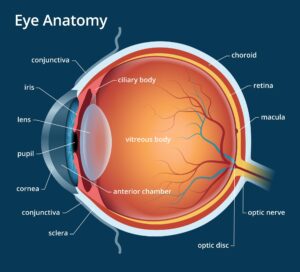
The purpose of the eye is to form a clear image of the object being viewed on the retina, and then to pass this to the brain for processing. The eye, like a camera, does this with lenses. The cornea, the clear window at the front of the eye, does most of the focusing work. The light passes through the pupil which controls the amount of light entering the eye and is then focused further by the lens inside the eye.
This lens is flexible and can be made fatter or thinner to give more or less focusing power to view near and far objects. To bring a distant object into focus the circular ciliary muscle relaxes against the wall of the eye, pulling the suspensory ligament to stretch the lens into a flatter, thinner form. For close focusing the ciliary muscle contracts, slackening the suspensory ligament and allowing the lens to return to a fatter, more rounded shape.
Source: https://fixdiagramfrancisco.z21.web.core.windows.net/schematic-diagram-of-human-eye.html
Finding the Focus
To find the focus the eye uses two cues. The brain can quickly bring both eyes to bear on the object of interest so that the images from both eyes join up, or fuse together. The brain can tell the eye roughly where to focus, from how much it had to pull the eyes together to fuse the images. Secondly, the eye moves the focus back and forth to find the maximum contrast, thereby bringing the image into focus. Try this experiment: hold a finger in front of your eyes as close as you can comfortably focus, now look at a far object and then look back at the finger. Notice how long it takes to come into focus. Now repeat the process using one eye only. If your vision is balanced between both eyes, you will notice how much slower you focus using one eye on its own.
Presbyopia: Small Print Problems
The lens in the eye is built up in layers, like an onion. New layers are constantly being added to the outside, compressing and hardening those in the centre. This results in a gradual stiffening of the lens over time. The ciliary muscle grows stronger to compensate for this, doubling in size between the ages of 20 and 40. Unfortunately, as we do our close work in relatively poor light with enlarged pupils, the eye is unable to focus as well as it might and the ciliary muscle does not get as much exercise as it needs. The growth of the ciliary muscle falls behind what is required for the closest focusing. This ‘near point’ gradually moves further away until by the mid-40s it starts to interfere with reading small print. This is called presbyopia. The conventional treatment for presbyopia is to place a lens in front of the eye to add the extra focusing power that the eye is unable to provide. This immediately brings print into focus but also leaves the ciliary muscle less work to do. With habitual use of reading glasses, the ciliary muscle gets less exercise and starts to get weaker, further reducing the ability to focus close up.

Our glasses can help with most focusing problems, even if you already use spectacles or lenses.
Improve your eyesight naturally
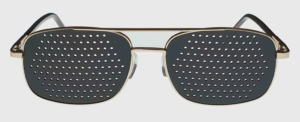
Our pinhole glasses have been developed from the traditional pinhole principal used in some eye tests. Our scientific research has enabled us to maximise their vision improvement effect.
World-class quality
With all our models assembled here in the UK, you are guaranteed a product of the highest quality. We oversee the production of the lenses ourselves to ensure that they meet our high standards, with the pinhole correctly sized. Buy Trayner Pinhole Glasses for a long lasting, quality product.
Affordable product
Our prices have remained consistently low, making sure that our products are affordable for every buyer. We stock models that vary in price, with some more fashionable versions, whilst always keeping the classic cheaper styles available for the money conscious buyer.
The author, Peter Duthie became involved with the manufacturing side of Trayner Pinhole Glasses in 1990 and started to help out at exhibitions. Fascinated by the improvements users reported in their vision, he gave up his work as an electronic design consultant so he could join Trayner and apply his engineering skills to unraveling the mysteries of vision improvement. As a result, he has succeeded in bringing pinhole glasses in from the fringe to a growing acceptance by opticians, doctors and ophthalmologists.
Would you like to choose which glasses that you should wear?
https://www.trayner.co.uk/shop
What size of resolution would be best for you?
Many Trayner users have found they can give up their conventional glasses.
https://www.trayner.co.u
Call to find out more today:
0800 071 2020
EMAIL sales@trayner.co.uk
CALL TELEPHONE FREEPHONE (UK): 0800 071 2020
INTERNATIONAL: +44 1752 927087
© COPYRIGHT 2024 TRAYNER PINHOLE GLASSES
All rights reserved
Namaste Note:
As you have read in Peter’s excellent article above, the eye is adaptable and, just like other parts of our body is able to improve whereas we have been programed to believe that our bodies cannot improve once the decline in health has begun, for whatever reason. The optical industry is just that and INDUSTRY as is everything else in mainstream medicine, it is geared to making MONEY!! We have been lied to on a vast scale, indoctrinated to accept the narrative without questioning. There are two videos below for your interest and consideration. Enjoy.
“This frequency can helps with people who’s suffering from blurr vision, Cataracts and retinal detachment. Eye disease is very common to a lot of people especially your sight will start to decline when you’re age 35 years old or above. And sometimes your vision will become worsen when you face a computer monitor for prolong periods, the blue light will cause damage to the vitreous humour, which is the liquid medium with the eye ball. First sign of damaged vitreous is floater or dark spot which will appears on your vision, if this is left untreated it will progress to a serious disease call retinal detachment which may lead to permanent blindness. If you’re using the computer everyday for work or suffering from degenerating eye sight, it’s recommended to listen to this video daily to minimize the chance of retinal detachment.”Source: https://www.youtube.com/@FrequencyHeal
Source: #Healingmusic #eyes #Healing
Experience a Healing journey for your vision with 10000Hz + 7 Eye Healing Frequencies. This unique meditation music is designed to enhance eye health, combining 432 Hz for consciousness tuning with 10000 Hz, known for its comprehensive healing properties, including full detox of the Pineal Gland. Dive deeper with specific frequencies targeted at eye health: 1600 Hz, 787 Hz, 393 Hz, and 350 Hz, each chosen for their association with treating eye disorders and improving vision. The soundtrack is further enriched with 40 Hz to optimize brain function in Gamma and 8 Hz for Theta manifestation, promoting overall well-being. Accompanied by meditative drums, this powerful blend offers a holistic approach to eye healing and wellness. #eyes #Healing #Healingmusic